
What Happened
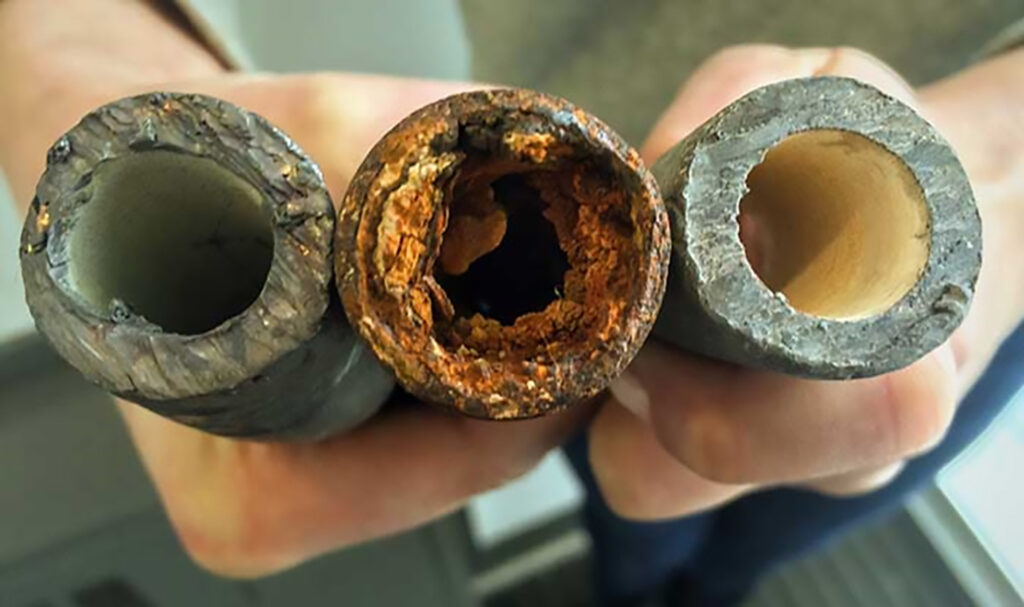
The City of Columbus, Ohio, filed a groundbreaking lawsuit today against seven companies1 that it claims had a role in producing or selling lead pipes used in city water service lines. These lead service lines (LSLs) connect the water main to homes and buildings in its water system and are the most significant source of lead in drinking water.
The complaint alleges that the companies created an “absolute public nuisance” and engaged in a “civil conspiracy” when they “deceptively promoted lead pipes and other lead-bearing plumbing components, falsely claiming they were safe to deliver tap water when Defendants knew they posed grave risks to public health.” It says the companies conducted a “decades-long campaign revolved around a lie: that lead, a known poison, could be trusted to deliver drinking water day in and day out in perpetuity. Defendants’ promotional efforts—their advertisements, product catalogs, technical publications, journal
articles, convention exhibits, films, training programs, classes, and more—grossly misrepresented, or simply ignored, the health risks from lead pipes and other lead-bearing plumbing components.”
It said “tens of thousands of lead service lines carry drinking water to homes, daycares, and other buildings in the City, and they pose a constant threat to the City’s drinking water quality. That threat is held in check only through the City’s extensive water treatment and other efforts. And as required by a new federal mandate, the City has now undertaken a comprehensive effort to find and remove all lead service lines, at enormous expense.”
The city asks the court to order the defendants to redress and abate the public nuisance by funding the replacement of the lead pipe. It estimates that it will need an additional $1.2 billion to remove all lead and galvanized pipes in its water system by 2037.
Why It Matters
EPA estimates that 4 million LSLs are in use across the nation and need to be replaced to protect public health from lead. In 2024, EPA improved its Lead and Copper Rule that mandates that utilities replace the vast majority of those lines by 2037. Just last month, EPA’s new leadership filed a compelling brief that vigorously defended the rule from a legal challenge by the American Water Works Association.
The estimated societal benefits of the rule over 35 years are huge, between $13 and $25 billion per year. This is far beyond the estimated costs of $1.5 to $2 billion per yearover the same period.
Nonetheless, EPA estimated that utilities will need to invest roughly $50 to 70 billion,2 most of it by 2037, to comply with the rule. Congress provided $15 billion to support the effort through its 2021 Infrastructure Investment and Jobs Act (aka Bipartisan Investment Law).3
Without further Congressional investment or other funding, ratepayers are likely to pay the difference.
Our Take
We applaud the City of Columbus for aggressively pursuing funding to replace LSLs from the industries who are primarily responsible for creating the public nuisance. The complaint makes a compelling case based on extensive documentation showing that the industry was aware of the harm and promoted lead pipes to utilities, plumbers, and waterwork engineers as a safer alternative to less expensive copper.
We recognize that litigation can be costly and time-consuming and have little doubt that the industry will vigorously defend itself. For that reason, we encourage other cities struggling to fund LSL replacement to consider similar actions so that they can also benefit from any resolution.
The case presents similar issues to the landmark 2017 decision by California courts. In that case, the 10 counties and cities successfully argued three companies created a public nuisance in the state by promoting the use of lead-based paint in the interior of residences built before 1951 even though they had actual knowledge of the harm the paint would pose to children. Those companies ultimately paid $305 million to the communities to remediate lead-based paint.
The Columbus case is stronger than the California one because:
- Columbus has a legal duty to remove the LSLs and will incur significant costs to accomplish this. In contrast, there was no legal duty for the California counties and cities to remediate the lead-based paint. While the harm to their residents was real, the cost was less tangible.
- Columbus benefitted from the extensive discovery that was made public through litigation in California and other communities showing the industry’s misleading practices.
- The California case was focused on remediating private property — people’s homes. LSLs are part of Columbus’ public infrastructure, simplifying the case.
Enjoying Unleaded Kids’ insights? Consider making a donation to help us continue our work.
Get Unleaded Kids’ insights delivered to your inbox as soon as they are published by joining our email list.
- NL Industries, Eaglepicher Technologies, ASARCO, Doe Run Resources, Atlantic Richfield, Edlow International, and Nuclead Manufacturing. ↩︎
- The estimate was based on an estimate of roughly 9 million LSLs. The amount may be lower if EPA’s updated estimate of 4 million LSLs holds true. Note that AWWA and others put the estimate at $90 to $100 billion. ↩︎
- Those funds were distributed to utilities by states through the Drinking Water State Revolving Fund (DWSRF) ↩︎