

For the past year, we have been watching to see how the Trump Administration approached protecting families from lead exposure as part of its Make America Healthy Again (MAHA) effort. Would it continue the impressive progress we saw in 2024 or roll those successes back as part of its deregulatory and budget-cutting efforts? One year in, we examine the signals and actions in a series of blogs.
In our earlier blogs in the series, we described the Trump Administration as taking positive actions regarding its commitment to protecting families from lead in drinking water and food. In contrast, we saw alarming rollbacks for lead in dust, soil, and paint and found CDC failing to regain traction after the DOGE-induced turmoil.
Now we turn to lead in air where the situation is bleak. EPA’s deregulatory agenda consistently overrides health concerns. Specifically, EPA has:
- Delayed compliance deadlines by at least two years for two major rules that would have significantly reduced lead emissions from three large primary1 copper smelters and from eight integrated iron and steel manufacturers. Both actions were unprecedented and suggested they might be weakened in the future. In 2024, the 11 facilities released almost 45,000 pounds of lead to the air,2 with 95% of the total in Gila, Arizona; Salt Lake City, Utah; and Northwest Indiana.
- Repealed a major rule that would have significantly reduced mercury and other hazardous air pollutants (including lead) from more than more than 300 large coal-fired and oil-power plants across the country. In 2024, those facilities released more than 11,000 pounds of lead.
- Proposed weakening existing standards for 11 secondary3 lead smelters. In 2024, those facilities released almost 8,400 pounds of lead, primarily in Boss, Missouri, and Lyon Station, Pennsylvania. Other facilities are in Alabama, Florida, Minnesota, Missouri, New York, and California.
- Finalized a major rule to reduce hazardous air pollutants (including lead) from 57 large municipal waste combustors that were weaker than proposed in 2024.4 Instead of the proposed 362 pounds/year in reductions, communities would see only by 82 pounds per year in cuts.
Despite these rollbacks and delays, in July, EPA Deputy Administrator David Fotouhi sent a letter to agency leadership stating that “[r]ecognizing the need to ensure continued progress in reducing lead exposure, the Trump Administration is reconstituting the Senior Lead Leadership Coordinating Committee . . . and a parallel operational Lead Coordinating Committee.”
FAA has, on the other hand, published a draft transition plan to phase-out leaded aviation gas by 2030 excepting Alaska, which has until 2032. Once complete, the phase-out will reduce lead air releases by more than 800,000 pounds per year. However, the draft plan relies on market forces and does not include milestones or regulatory deadlines that are likely needed for the effort to meet the deadlines.
But first some context . . .
Why are Tighter Standards Important?
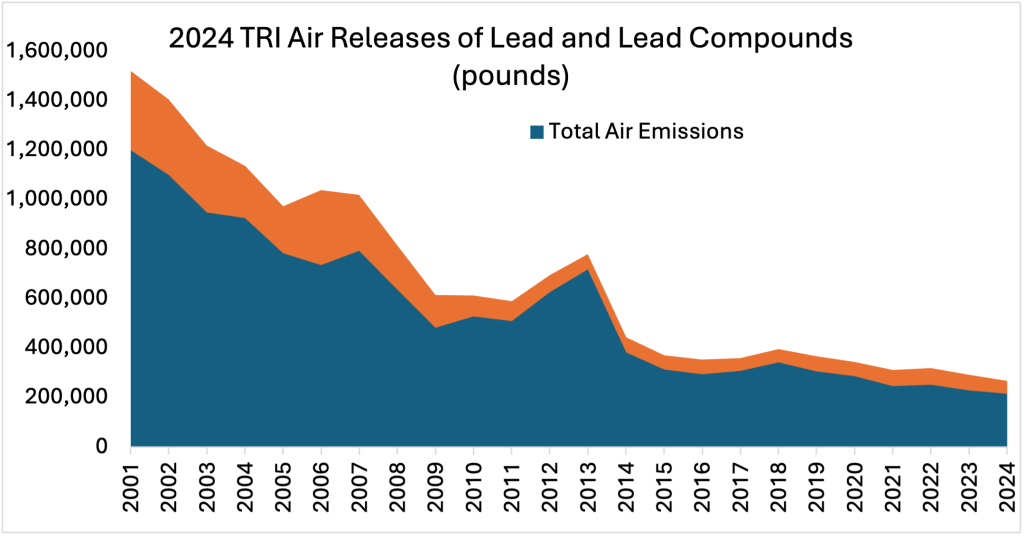
More than 2,500 industrial facilities in 224 different industries reported to EPA through the Toxic Release Inventory (TRI) in 2024 that they released a total of more than 267,000 pounds of lead and lead compounds into the air.5 This is roughly one-third of the annual releases from leaded aviation gas, which EPA determined in 2023 to reasonably be anticipated to endanger public health and welfare.
While every state had a facility that reported releasing lead into the air, Arizona tops the list with more than 10% of the nation’s total followed by Alaska, Indiana, Utah, Kentucky, Iowa, Texas, Pennsylvania, and Missouri. Mining, metal processing, cement/concrete manufacturing, and fossil fuel power generation are primary sources.
Overall, air releases from industrial facilities dropped an astounding 76% between 2001 and 2015, overcoming a surge in 2012 and 2013. However, progress slowed dramatically during the past ten years with a 28% drop. See figure below. Had EPA rules not been delayed or repealed, they likely would have accelerated progress between 2025 and 2027.
Comparing EPA’s 2024 Milestones with 2025 Actions
Primary Copper Smelters: In May 2024, EPA tightened existing hazardous air pollutant (HAP) standards for three primary copper smelters. These facilities process copper ore into metallic copper that has a myriad of uses including as the most common replacement for lead pipes. They primarily support nearby copper mines.
The smelters reported releasing a total of more than 35,600 pounds of lead into the air in 2024, down significantly from prior years. It also reported 53 pounds of lead to surface water and more than 5.7 million pounds on-site to the land. The smelters also released significant amounts of arsenic and other HAPs.
Two of the smelters, including Freeport-McMoran, the largest lead air source in the country, are in Gila County, Arizona. The other smelter recently closed and is being cleaned up. Until recently, it was in the top five nationally. The third smelter is in Salt Lake City and was the third highest in the nation in 2024.
After an extensive review of the available technologies and the residual risks, EPA concluded the three smelters could and should reduce releases of lead, arsenic, and other HAPs by 16,000 pounds per year. Most of these reductions would occur during startup, shutdown, and malfunctions. The company challenged the standard as too strict. The nearby San Carlos Apache Tribe also went to court arguing it was too weak.
While the lawsuits proceeded, in October 2025, using a never-before-used provision6 of the Clean Air Act, President Trump declared that it is in the national security interests to delay compliance for two years. Without referring to any new evidence, the President claimed the technology to implement the rule does not exist. This contradicted the extensive evidence in the public docket and analyzed by EPA. The provision allowed the President to renew the declaration every two years.
In December 2025, a New York Times investigation revealed the flimsy basis of the decision. According to the article, Freeport-McMoran requested the Presidential Declaration but “did not have to present an exhaustive argument for why it deserved a reprieve. There was no economic analysis or engineering study. It was as easy as sending an email to [EPA].”
Integrated Iron and Steel Manufacturing: In April 2024, EPA tightened HAP standards for nine integrated iron and steel manufacturing facilities. These mills make iron and steel from limestone, coke from coal, and iron ore.
The facilities are owned by two companies, Cleveland Cliffs and U.S. Steel. In 2024, they reported releasing a total of more than 8,700 pounds of lead to the air as well as more than 1,200 pounds of lead to surface water and more than 477,000 pounds on-site to the land. They also release a myriad of other HAPs.
Four of the facilities are on Northwest Indiana’s 43-mile Lake Michigan shoreline where they release 76% of the lead from all nine facilities. The others were in Ohio, Pennsylvania, Illinois, and Michigan. EPA acted in response to a 2015 lawsuit filed by Earthjustice on behalf of impacted communities.
After an extensive review of the available technologies and the residual risks, EPA concluded the facilities could reduce hazardous air pollutants, especially from five previously unregulated operations at the facilities.
In March 2025, EPA issued a partial stay of the standard and, after getting public comments, in November 2025, issued an interim final rule extending the deadline to April 2027 because “subsequent developments have shown to be untenable from a compliance perspective on the time frames set out in the 2024 rule.” The announcement indicated the rule make be weakened in the future. Representing impacted communities, Earthjustice has challenged the action.
Coal- and Oil-Fired Power Plants: In May 2024, EPA issued a major rule, commonly known as the Mercury and Air Toxics Standards (MATS), tightening 2012 standards for more than 300 large power plants that burn coal or oil in almost every state. Pennsylvania has 22 of the plants followed by Texas with 17, Illinois and Indiana with 15 each, and Kentucky, Michigan, and Missouri with 13 each.
While mercury is the primary HAP, we found 187 of the plants reporting releases of lead into the air in 2024 pursuant to TRI. They had total lead releases of more than 17,700 pounds to air, along with more than 1,700 pounds to water and more than 1.9 million points on-site to the land.
On February 19, 2026, EPA repealed the 2024 rule restoring the 2012 version of the rule claiming it will save an “expected $670 million in regulatory compliance costs savings in the form of lower costs of transportation, heating, utilities, farming, and manufacturing, and more reliable energy.”
Secondary Lead Smelters: In 2012, when EPA tightened emission standards for secondary lead smelters, it estimated that the facilities were releasing more than 25,000 pounds per year. Twelve years later, the industry reported to TRI that they released almost 8,400 pounds of lead in 2024, a 66% reduction.
Almost 75% of those reported releases were from smelters in Boss, Missouri, and Lyon Station, Pennsylvania. Other facilities are in Alabama, Florida, Minnesota, Missouri, New York, and California. The facilities also reported releases of 1,623 pounds of lead to surface water and more than 3.8 million pounds on-site to the land.
After losing a series of court decisions regarding how it established emissions standards for HAPs, EPA needed to revise the secondary lead smelter rule to tighten limits, especially for startup, shutdown, and maintenance activities where the emissions can spike higher. EPA proposed revisions to the standards in October 2025.
While EPA did not estimate the potential emission reductions from the proposal, Earthjustice and eight other organizations submitted comments claiming the proposal “fails to follow the law or meet the moment” saying EPA “proposed not to require much-needed reductions of lead, arsenic, cadmium, or other hazardous air pollutants from lead smelters, and — and in some cases to weaken — the 2012 emission standards.” They said “during the last 13 years, a number of important developments in practices, processes, and control technologies have occurred at individual facilities and in local air standards and permits that show greater lead and other HAP emissions are “achievable” and “necessary” to take into account under the Act.”
Municipal Waste Combustors: In January 2024, EPA proposed tightening standards for large municipal waste combustors that would revise emission limits and remove an exception for startup, shutdown and malfunctions. The proposal would reduce HAP releases (including lead) from 57 facilities, tightening the emission limits by 86% to 56 micrograms/dry standard cubic meters (µg/dscm). New combustors would be limited to 13 µg/dscm. The rule would reduce lead emissions by 362 pounds/year and, over 20 years, provide benefits that would be 2 to 8 times greater than the investment.
On March 10, 2026, EPA finalized the rule that was weaker than 2024 proposal.7 The rule sets less protective lead emission limits of 68 µg/dscm for existing combustors and 23 µg/dscm for new ones. EPA estimated that final rule will reduce lead emissions by 82 pounds per year. The combustors are spread across the country—primarily around urban areas.
Leaded Aviation Gas: After years of analysis, EPA finally determined in October 2023 that emissions of more than 800,000 pounds of lead annually from the use of more than 180 million gallons of leaded aviation gas may reasonably be anticipated to endanger public health and welfare. This action triggered a statutory duty for EPA to establish emission standards and for FAA to adopt fuel standards and certification standards to ensure compliance.
In May 2024, with Administration support, Congress directed8 the agencies and industry to safely replace leaded fuel with unleaded alternatives by the end of 2030, with the exception of Alaska, which has until 2032.9 The law required FAA to develop a Transition Plan to guide the process.
In January 2026, FAA released a draft Transition Plan outlining a framework to meet the deadline. The plan consists of four phases: fuel authorizations and comparisons; gain market experience; national transition; and Alaska transition. Unleaded Kids submitted comments in support of the draft transition plan but with extensive improvements. As we explained in our blog, the plan has three significant shortcomings:
- No description of the public health concerns that are motivating FAA and the aviation community to seek alternative fuels.
- No dates for key interim milestones so stakeholders can evaluate whether the plan is on track to meet deadlines.
- No milestones for FAA and EPA to issue regulations essential to shaping market forces and meeting the deadlines.
EPA’s Spring 2025 regulatory agenda does not mention rulemakings related to lead in aviation fuel, even as a long-term action. This omission undermines the prospects that the necessary rules will be in place by 2030.
Note to Our Readers About Unleaded Kids’ Oversight of Lead in Air
In researching this blog, we realized that this is only our second blog focused on lead in air, with the first coming just last month. The omission is disconcerting because air releases are the epitome of primary prevention—a top public health priority. Every pound of lead air pollution prevented is one less pound that will accumulate in communities around the sources and eventually harm someone or have to be cleaned up at much greater cost to society.
After some self-reflection, we identified two reasons for the oversight:
- Industrial facilities vary widely: Unlike paint, pipes, telecom cables, or food, industrial facilities vary widely, each with their own issues.
- Earthjustice’s leadership: Earthjustice and the environmental non-profits it represents have been compelling advocates for the communities most impacted by those industry facilities. We applaud the Earthjustice10 for its vigilance and persistence. As a result, there was less that Unleaded Kids had to say on the issue—until this blog.
We encourage those working to protect families from lead to learn about the industrial facilities with air releases in the communities they serve and put primary prevention into action. Contact us so we can provide you with details.
Enjoying Unleaded Kids’ insights? Consider making a donation to help us continue our work.
Get Unleaded Kids’ insights delivered to your inbox as soon as they are published by joining our email list.
- Primary smelters process ore from mines. ↩︎
- Pounds are based on Toxic Release Inventory (TRI) reports for lead and lead compounds submitted by the affected facilities in 2024. ↩︎
- Secondary smelters process recycled metal. ↩︎
- Unlike for the four other rulemakings, municipal waste combustors are not required to report toxic chemical releases to TRI. As a result, we do not have comparable totals. In 2023, the Energy Justice Network and the Public Employees for Environmental Responsibility (PEER) petitioned EPA to require the facilities to report. In December 2024, EPA granted the petition, but has not yet issued a proposed rule. ↩︎
- Note that the TRI may underestimate fugitive emissions from these industrial operations. For alternative, consider EPA’s National Emissions Inventory. Its latest facility estimates are from 2021. ↩︎
- See statutory notes to 49 U.S.C. § 44714. ↩︎
- Unlike for the four other rulemakings, municipal waste combustors are not required to report toxic chemical releases to TRI. In 2023, the Energy Justice Network and the Public Employees for Environmental Responsibility (PEER) petitioned EPA to require the facilities to report. In December 2024, EPA granted the petition, but has not yet issued a proposed rule. ↩︎
- See statutory notes to 49 U.S.C. § 44714. ↩︎
- Alaska was given two more years because of its dependence on piston-engine aircraft and cold-weather challenges in making the transition. ↩︎
- Emma Cheuse, Adrienne Lee, Kelly Lester, Michelle Mabson, Nicholas Morales, Jim Pew, Tosh Sagar, and Jonathan Smith. ↩︎