
For the past year, we have been watching to see how the Trump Administration approached protecting families from lead exposure as part of its Make America Healthy Again (MAHA) effort. Would it continue the impressive progress we saw in 2024 or roll those successes back as part of its deregulatory and budget-cutting efforts? Twelve months in, we examine the signals and actions in a series of blogs.
In our earlier blogs in the series, we described the Trump Administration as taking positive actions regarding its commitment to protecting families from lead in drinking water and food. In contrast, we saw alarming rollbacks for lead in dust, soil, and paint. Now we turn to lead in people — children and adults.
Let’s start by describing CDC’s 2024 milestones regarding lead in children and adults:
- Adult Lead Exposure: As we described in a blog, at its December 11 meeting, CDC’s Lead Exposure Prevention Advisory Committee (LEPAC) adopted an impressive report calling for measures to protect adults from the harmful effects of lead exposure. It stated that “The magnitude of lead-related risk is on par with that of other prominent cardiovascular risk factors, such as elevated cholesterol, smoking, and hypertension, that have been the focus of extensive public health concern.” The report makes 16 groundbreaking recommendations with detailed justifications for each.
- Point-of-Care Blood Lead Monitoring: As we described in a blog, CDC announced results of its Lead Detect Prize program that awarded a total of $1 million over the past year to five teams developing new and improved point-of-care devices to measure blood lead levels from capillary samples taken in the field by pediatricians, health departments, and others. Getting accurate results from these point-of-care devices will enable healthcare providers to give families the advice they need to take action when elevated blood lead levels are found.
- Applesauce Pouch Recall: CDC supported FDA on the massive recall of applesauce pouches from Ecuador that were contaminated with high levels of lead chromate. The agency primarily tracked cases and coordinated outreach within the public health community.
While not CDC, in late 2023, EPA released NHANES’ children’s lead biomonitoring results for 2019–20 through its America’s Children and the Environment (ACE) project. The data shows that children below the poverty level continue to be at greatest risk. It also suggests the decline in blood lead levels may be continuing and that the increase in 2015–16 data was an anomaly—a positive sign. The data on CDC’s NHANES website stops at 2018. We will know more when CDC releases summaries of its post-pandemic data.
We explore below how CDC has approached lead in people under the current Trump Administration.
Confusion, Trauma from Firings and Reinstatements
On April 1, the Department of Health and Human Services (HHS) summarily fired CDC’s Childhood Lead Poisoning Prevention Program (CLPPP) employees as part of the mass terminations at CDC and other health agencies. The 26 staff in the CLPPP were placed on administrative leave with termination scheduled for June 2.
Two days later, after outcry from the lead poisoning prevention community and others, HHS Secretary Robert Kennedy Jr. told ABC News in response to a question about the CLPPP cuts that the program was mistakenly cut and would soon be reinstated. Inexplicably, HHS quickly walked back the decision saying the reinstatement would not happen.
On May 20, Secretary Kennedy in testimony to the Senate Appropriations Committee responded to questions about the CLPPP from Senator Tammy Baldwin (D-WI) and Senator Jack Reed (D-RI). Secretary Kennedy said HHS was “continuing to fund the program”1 and that it would spend the appropriated funds. He testified that “my understanding is that that program is continuing” and he would talk to Senator Reed further.2 He also committed to Senator Baldwin that he and his staff would respond to requests for information from her or her staff.3
On May 22, NBC News reported that Erik Svendson, director of CDC’s Division of Environmental Health Science and Practice that includes the childhood lead program, said that no CLPPP staff had been reinstated, with layoffs set to take effect in less than two weeks.
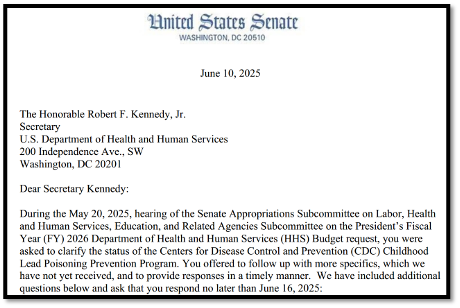
On June 10, Senators Baldwin and Reed sent Secretary Kennedy a follow-up letter asking for written answers about the CLPPP firings. The questions included:
- “Was the decision to terminate the staff within the Childhood Lead Poisoning Prevention branch a mistake?”
- “How much funding has been spent by the Program since January 20, 2025?”
- “Has the CDC deployed any teams or provided technical assistance related to the Lead Poisoning Prevention Program since the April 1st reductions in force at HHS? Please outline any activities or work conducted by the Program since this date.”
The next day, CNN reported4 that HHS had reinstated more than 450 CDC employees including the CLPPP team.
Despite Secretary Kennedy’s promises to the contrary in his Senate testimony, we were unable to confirm with staff in Senators Baldwin and Reed offices whether or not he responded to the June 10 letter.
Recognizing the problem, in its bipartisan July 31, 2025 report, the Committee’s report said
“Additionally, the Committee is disappointed by the recent upheaval in the Childhood Lead Poisoning Prevention Program, caused by the terminations of the entire branch’s staff, before those terminations were reversed months later. The funding provided in this act is intended to support the program’s activities as they existed in fiscal year 2024.”5
Unleaded Kids recognizes that layoffs are challenging under any circumstances. They can be traumatic to staff, not just those laid off but also to those who remain. Secretary Kennedy’s and HHS’s inconsistent communications and unwillingness to answer the questions have made the trauma worse, most likely leaving staff hesitant to act or make decisions. It is inexcusable, and it leaves programs and lives in jeopardy.
Year 5 Funding to 62 State, Local Health Departments
The CLPPP program provides funding in five-year cycles to lead poisoning prevention programs in 62 state and local health departments. When CLPPP staff were fired, the grant was in year 4 of the cycle with the fifth year starting on October 1, 2025. The staff distributed the funding in a timely manner after they returned to work.
The CLPPP now must start another five year cycle on October 1, 2026. To accomplish this, they must issue a request for proposals, review the proposals, and issue grants as appropriate with the $51 million appropriated by Congress.
Unleaded Kids will be watching the process closely to see if it goes smoothly.
CDC Failed Milwaukee Kids in Time of Need
In January 2025, Milwaukee Health Department notified Milwaukee Public Schools about elevated blood lead level (EBLL) investigations in four schools. Over the next two months, many more schools were investigated. The health department shuttered six schools and displaced 1,800 children. On April 28, the health department and the public school system agreed to an action plan.
As they were developing the plan, Milwaukee Health Department sought CDC CLPPP guidance and assistance. They had weekly calls with CLPPP until early April. According to a CNN report, Milwaukee officials received an email from a CDC epidemiologist telling them “my entire division was eliminated today,” apologizing that she wouldn’t be able to continue working with the city on the response and referring them to other points of contact within the agency.
At Secretary Kennedy’s testimony to the Senate Appropriations Committee on May 20, Senator Baldwin asked him about the lack of technical support. Later in the hearing he said CDC has “a team in Milwaukee and we’re giving laboratory support to the analytics in Milwaukee and we’re working with the health department in Milwaukee.”6 He did not address whether the CLPPP was providing the technical support beyond the lab aspect.7
On June 10, Senators Baldwin and Reed sent Secretary Kennedy a follow-up letter asking for written answers about the CLPPP firings. The questions included:
- “Does HHS have the ability to reinstate employees from the Childhood Lead Poisoning Prevention branch in order to deploy to areas like Milwaukee, Wisconsin that are in need of assistance?”
- “During the hearing, when asked about the status of the Program, you said that a team from the Program was on the ground in Milwaukee to deal with the ongoing crisis of lead contamination in schools. The City of Milwaukee has refuted that claim. Has CDC sent any staff to Milwaukee in response to their request for technical assistance to help with the lead issue in schools? This request is unrelated to the support that was provided to the state last month to certify and calibrate lab equipment.”
Despite Secretary Kennedy’s promises to the contrary in his Senate testimony, we were unable to confirm with staff in Senators Baldwin and Reed offices whether or not he responded to the June 10 letter.
In its July 31 bipartisan report, the Senate Appropriations Committee directed CDC to continue “offering technical assistance for lead exposure events, including through the deployment of CDC Childhood Lead Poisoning Prevention branch staff to localities requesting assistance after a lead exposure event.”
From Unleaded Kids’ perspective, CDC failed the children of Milwaukee in their time of need.
LEPAC is Missing In Action
After the Flint water crisis, Congress recognized the need for a more focused and coordinated federal effort to protect people from lead exposure. In 2016, it directed CDC to create LEPAC with the chair and at least half of members representing federal agencies and the balance from experts in the field. Its responsibilities included:
- “review the Federal programs and services available to individuals and communities exposed to lead;
- review current research on lead poisoning to identify additional research needs;
- review and identify best practices, or the need for best practices, regarding lead screening and the prevention of lead poisoning;
- identify effective services, including services relating to healthcare, education, and nutrition for individuals and communities affected by lead exposure and lead poisoning, . . . ; and
- undertake any other review or activities that the Secretary determines to be appropriate.”
CDC established LEPAC in 2018 with HUD’s Matt Ammon as its chair. Beyond meeting at least annually and approving an annual report in 2020 to 2024, the committee provided crucial recommendations on dropping the agency’s blood lead reference value to 3.5 µg/dL in 2021 and preventing lead exposure in adults in 2024.
In 2025, LEPAC was missing in action. It failed to release the final version of Prevention of Lead Exposure in Adults (PLEA) that was approved with minor modification in December 2024. It also failed to meet in 2025.
From Unleaded Kids’ perspective, LEPAC serves as a critical forum to provide thoughtful recommendations regarding lead exposure prevention and helps resolve issues that involve multiple federal agencies. Its failure to meet in 2025 is a warning sign that contradicts Secretary Kennedy’s promise of radical transparency.
We encourage CDC to ensure LEPAC meets early in 2026, releases the final PLEA report, reassesses the blood lead testing guidelines for pregnant people, and reconciles EPA’s choice of 5 µg/dL as a target level for cleanup of residential soil with the blood lead reference value of 3.5 µg/dL.
A Bright Spot
In early December CLPPP highlighted success stories by its state and local grantees. award recipients provide CDC with updates on their program’s successes. They featured 10 states (Georgia, Louisiana, Minnesota, New Hampshire, North Carolina, Ohio, Oregon, Utah, West Virginia, and Wisconsin) and five local programs (Harris County, TX; Los Angeles County, LA; Marion County, IN; Salt Lake County, UT; and Washington, DC). Congratulations to these programs, especially Utah for having two successes.
Enjoying Unleaded Kids’ insights? Consider making a donation to help us continue our work.
Get Unleaded Kids’ insights delivered to your inbox as soon as they are published by joining our email list.
- See recording at 1 hour 12 minutes ↩︎
- See recording at 1 hour 12 minutes ↩︎
- See recording at 48 minutes. ↩︎
- CNN said that Fox News first reported the reinstatement. We followed the link and it was broken. A search for “CDC reinstated June 11” on Fox News website shows the article but that link was also broken. ↩︎
- See PDF on page 91–92 of 451. ↩︎
- See recording at 1 hour 12 minutes. ↩︎
- A May 20 NBC News Report said that the “Milwaukee Health Department said that Kennedy’s statement was inaccurate, and that the city had not received any federal epidemiological or analytical support related to the lead crisis in contrast to the weekly calls they had with CDC to develop a plan to screen tens of thousands of students for lead poisoning.” The health department’s spokesperson, Caroline Reinwald, said that the federal government’s only recent involvement in the lead crisis was “a short, two-week visit from a single CDC staff member this month, who assisted with the validation of a new instrument in our laboratory.” “This support was requested independently of the [Milwaukee Public Schools] crisis and was part of a separate, pre-existing need to expand our lab’s long-term capacity for lead testing,” Reinwald said in a statement. ↩︎