
What Happened
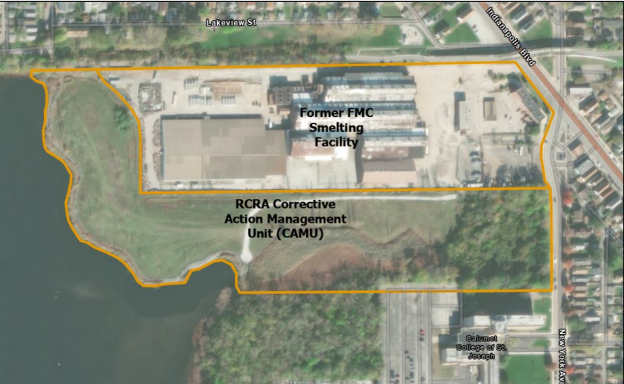
EPA proposed an interim cleanup plan in March 2026 for the Federated Metals Superfund Site in Northwest Indiana1 where a secondary lead smelter released lead dust into nearby neighborhoods when it operated from 1937 to 1983. The agency said it planned to clean up contaminated soil from 160 residential properties2 with documented soil-lead levels greater than 200 parts per million (ppm) in the top 12 inches of soil. Eventually, the final cleanup will consider roughly 3,800 additional properties that have not yet been sampled.
The proposed plan is one of the first to apply EPA’s October 16, 2025, “Residential Lead Directive for CERCLA Sites and RCRA Hazardous Waste Cleanup Program Facilities,” (“2025 Lead Directive”). The directive weakened one issued in January 2024 by the previous administrator. Unleaded Kids, the National Safe and Healthy Housing Coalition, and others have raised significant concerns about the 2025 Lead Directive.
Recognizing the precedent the proposal may have not only on this site but on cleanups around the country, Unleaded Kids took a detailed look at it. On April 6, we submitted comments to EPA raising three concerns. The Plan:
- Substantially underestimates the risk by improperly applying EPA directives for cleanup of residential soil contaminated with lead.
- Does not specify what the maximum concentration of lead will be in the replacement soil.
- Sets a target for children’s blood lead level (BLL) that is inconsistent with public health goals.
Why It Matters
Lead is one of the most common hazardous substances found at the thousands of Superfund, hazardous waste, and other places where industrial and commercial operations have contaminated a community and threatened residents’ health. The lead contamination can be particularly significant near lead smelters, copper smelters, and iron and steel manufacturing.
Starting with aggressive remediation goals is critical because EPA uses the goal as the best that should be done at the site. Often the cleanup levels are less protective than the goal because the agency balances the public health benefits against the cleanup costs, timing, and available funding. To support the effort, EPA:
- Engages the community in a multi-step process through community advisory groups, public meetings, and opportunities to comment to shape the plan, especially when the goals cannot be met.
- Creates helpful webpages for each potential Superfund site that summarize the situation and plans for the site as well as provides one-stop shopping for available documentation.
- Reassesses the plan every five years by comparing the cleanup levels to the latest public health evidence and goals.
Unleaded Kids has previously covered EPA’s cleanup actions in blogs at Trenton Historic Properties in New Jersey, Tar Creek in Northeast Oklahoma.
Our Take
Setting aside our significant concerns with EPA’s 2025 Lead Directive, the agency must at least follow its own guidance, as well as the science, when setting cleanup standards for individual sites.
Unfortunately, in its proposed interim cleanup plan for Federated Metals, EPA cut a corner by improperly applying its soil-lead remediation goal of 200 ppm to the total soil sample instead of just the fine fraction of particles that passes through a sieve. From 2000 to 2016, EPA’s soil sampling guidance recommended a 250 micrometer (µm) sieve. In 2016, EPA tightened its recommendation for sieving soil samples to 150 µm. For context, a 250 µm screen3 results in a fine fraction similar to all-purpose flour. A 150 µm screen results in a fine fraction that is similar to powdered sugar.
It may seem like a minor issue, but it is not because, according to EPA’s soil sampling guidance,4 the fine fraction:
- Is likely to have substantially higher levels of lead than the coarse fraction. Basing the goal on the total sample will underestimate the risk to residents by as much as 13 times.5
- Has increased potential for incidental ingestion based on it being more likely to stick to skin and accumulate indoors from wind-blown soil and tracking in on clothes, shoes, pets, toys, and other objects.
While EPA’s 2025 Lead Directive is silent on whether the soil sample must be sieved, the document makes clear that its blood lead model6 was used to correlate the 200 ppm goal to the likelihood of meeting the BLL of 5 µg/dL. Specifically, it said that “protectiveness to have been achieved at the vast majority of residential soil lead sites when there is no more than a 5% probability of exceeding a BLL of 5 µg/dL considering all exposures to lead for the child receptor.”
We do not understand why EPA’s 2018 sampling plan for the Federated Metals failed to ensure that soil samples were sieved into separate fine and coarse fractions. Based on a review of some other site plans, we do not think Federated Metals is an isolated incident.
To avoid delays in the cleanup, we recommended that EPA use a conversion factor to estimate the lead levels in the finer fraction based on the total soil sample from a site with a secondary lead smelter like the one at Federated Metals. We reviewed the references in EPA’s 2016 update to its 2000 soil sieving guidance and suggested that the cleanup goal be no less protective than 100 ppm. At this level, we calculated that as many as 26 more properties beyond the 160 in the current plan would get cleaned up. This increase is reasonable and appropriate.
We made this recommendation because Tawinteung et al., 2005 evaluated soil contamination from a secondary lead smelter and found that the particles smaller than 150 µm were two times higher than was in the total sample.
We encourage those working to protect residents from cleanup sites to take a close look at the sampling plan and make sure they are sieving samples and comparing the remediation goal to the fine fraction.
Enjoying Unleaded Kids’ insights? Consider making a donation to help us continue our work.
Get Unleaded Kids’ insights delivered to your inbox as soon as they are published by joining our email list.
- Specifically, Hammond and Whiting, Indiana. ↩︎
- Residential properties consist of single- and multi-family dwellings as well as other areas where young children may be exposed to contaminated soil such as vacant lots in residential areas, schools, daycare centers, community centers, playgrounds, parks, green ways, and other recreational areas. ↩︎
- Sieves are commonly referred to by a number. A No. 60 sieve is for 250 µm and a No. 100 sieve is for 150 µm ↩︎
- The guidance was first issued in 2000 and strengthened in 2016. ↩︎
- In its 2016 revision to soil sieving guidance, EPA considered Beckwith et al. 1985 which analyzed street dust. The fraction that was 63-125 micrometers in pavement and gutter samples only was 6 to 13.3 times higher than concentration in corresponding 500-1000 micrometer size fraction. ↩︎
- Using the Integrated Exposure Uptake Biokinetic (IEUBK) model for lead in children. ↩︎