

| Soil-lead hazard. Since 2001, “a soil-lead hazard is bare soil on residential real property or on the property of a child-occupied facility that contains total lead equal to or exceeding 400 parts per million (µg/g) in a play area or average of 1,200 parts per million of bare soil in the rest of the yard based on soil samples.” 40 CFR 745.65 |
EPA plans to publish a proposed rule by February 2027 that would tighten its lead-based paint soil-lead hazard standards (“LBP Soil-Lead Standard”) consistent with the 2021 order of the Ninth Circuit Court of Appeals. The current standards were set in 2001.
The rule is likely to have significant implications for lead poisoning prevention efforts as it is becoming increasingly clear that soil is an important route of exposure to lead as it can:
- stick to skin and be ingested from hand-to-mouth activities.
- build up indoors as dust from wind-blown soil where can be ingested and inhaled.
- be tracked in on clothes, shoes, pets, toys, and other objects where it can be ingested.1
Given the implications, Unleaded Kids is using this blog to start the discussion now so stakeholders can prepare to respond to the proposed rule. If some good ideas or a consensus emerges, we can share them with EPA to inform its proposal. It is not too early. EPA should already be deep into the analysis of options to consider and their implications.
While we are not privy to any details, EPA’s actions in the past two years provide us with an idea of the issues and framework the agency may use. We think EPA will:
- Follow 2021 Ninth Circuit Court of Appeal Order: The court held that the hazard standard must be based solely on health considerations while clearance levels can also take into account reliability, effectiveness, and safety.
- Use dust-lead standard as a template: In October 2024, EPA revised its dust-lead standards: 1) designating any lab reportable levels of dust-lead on floors or interior window sills as a hazard; and 2) setting an action level of 5 micrograms per square foot (µg/ft2) on the floor, 40 µg/ft2 on interior window sills, and 100 µg/ft2 on window troughs. We expect the proposed rule will have the same approach for its LBP Soil-Lead Standards, though EPA may bring in background levels in some way.
- Try to be consistent with Superfund residential soil cleanup guidance: While the lead-based paint soil-lead standards have not changed in 25 years, EPA has periodically refined its guidance for collecting, processing, and evaluating samples from commercial and industry operations based on a greater understanding of the risk. As a result, EPA’s calls for the samples to be sieved to 150 micrometers (µm) and sets a preliminary remediation goal of 200 parts per million (ppm) based on the fine fraction of the sample—the portion that passes through the sieve is most likely to result in exposure to lead. While consistency is not required, differences should be rational.
As described below, we recommend:
- Sieve soil samples to 250 µm: EPA’s soil-lead standard should require that soils be sieved to 250 µm and the action level be based on the fine fraction. Where there is sufficient information, the standard should allow risk assessors to avoid sieving a sample by applying a validated enrichment factor to a total sample that a lab analyzes or to an XRF reading as a means of estimating the fine fraction.
- Hazard is any reportable lead level: Any reportable level of soil-lead by an NLLAP lab is a hazard. When communicating that a soil-lead hazard is present, the risk assessment should compare the levels to backgrounds based on the mean or the 95% upper confidence level for the state based on USGS studies.
- Soil Use: Samples be taken for any garden areas where produce is grown in addition to bare soil in play areas, driplines, and the rest of the yard.
- Sample depth: Gardens, sandboxes, and bare soil should be sampled down to 12, 6 and ½ inches respectively.
- Action levels: For garden soil, the action level should be based on background. For other bare soil, the action level should have no more than a 5% probability of exceeding a BLL of 3.5 µg/dL considering all exposures to lead for the child. Based on EPA’s blood lead model, that is 100 ppm. EPA should adjust the level as it refines its models and as CDC updates its BLRV.
Total or Fine Fraction: To Sieve or Not to Sieve
A threshold issue EPA must consider is whether the soil-lead standard should be based on the total sample or only the “fine fraction”—the portion that has passed through a 150 µm sieve. For context, this fine faction resembles baking flour.
The current LBP Soil-Lead Standard is based on the total sample without screening or sieving.2 When EPA promulgated it in 2001, the agency did not consider whether the sample should be sieved. Inexplicably, around the same time, EPA’s Superfund cleanup guidance called for samples to be sieved to 250 µm to better represent the risk of ingestion. In addition, EPA’s blood lead models use the fine fraction—not the total sample—to evaluate the risks. That means you must know the lead level in the fine fraction to estimate the risk.
In 2016, EPA reexamined the evidence and reduced the sieve size from 250 µm to 150 µm stating:
- “As shown in Figure 1, approximately 90% of the cumulative mass of soil adhered to children’s hands falls within the <150 µm fine fraction.”
- “Smaller particles are more mobile than larger fractions and are more likely to accumulate in the indoor environment, as a result of deposition of wind-blown soil or track-in transport of soil on clothes, shoes, pets, toys, and other objects, providing additional opportunity for exposure to this particle size fraction.”
- “Particle size distribution of metals in shooting ranges, incinerators, mine tailings and associated background soil samples from three mining sites, as well as urban soils and dusts demonstrated consistent enrichment in particle size fractions smaller than <150 µm.”
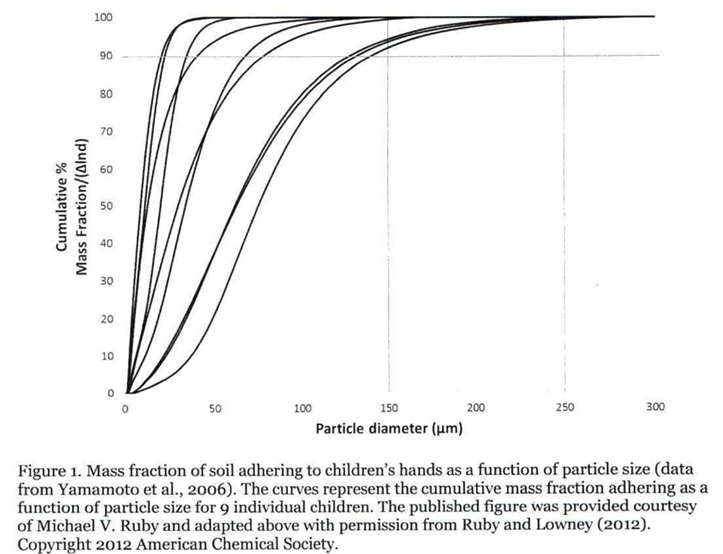
“Enrichment” is a way of saying that levels of lead in the fine fraction are consistently greater than in the coarse fraction of the total sample. The “enrichment factor” is a measure of how much greater the fine fraction is compared to the coarse fraction. It can range from roughly 1.5 to 9 times greater, though none of the studies have addressed urban soils in the US impacted by lead-based paint rather than industrial operations.
The bottom line is that the scientific evidence clearly supports basing the soil-hazard standard on the fine fraction as that provides the best assessment of the exposure risk.
The problem with sieving is that it increases the cost of lab analysis as well as turnaround times. Both are important considerations when investigating and a child’s elevated blood level or clearing a project after lead-based paint abatement.
The lab must ensure the samples are dried to less than 10% moisture and then pass the sample through the fine sieve. That is more complicated than the current approach of adding nitric acid to the soil sample and analyzing the filtrate.
We found an impressive January 2025 study of soil contaminated by lead mining and smelting in Butte, Montana, that compared the merits of sieving at 150 µm per EPA’s 2016 recommendation with 250 µm per EPA recommendation from 2000 to 2016. The study found that “screening these samples to <150 μm requires significantly more sample mass and laboratory processing time and space.” The finer fraction has statistically significant enrichment, but the difference was relatively low at the concentrations between 50 and 400 ppm where cleanup decisions require a better understanding of the risk. It concluded that “reliance on the <250 μm versus <150 μm sieve size is unlikely to significantly alter site assessments.”
Other issues:
- Visual assessment: HUD and EPA guidelines call for bare soil to be visually assessed for paint debris. If paint debris is seen, the soil fails the visual assessment and must be cleaned up. As a practical matter, the visual assessment complements the use of the fine fraction because it addresses the risk the paint will further degrade as well as the potential for pica as a child may eat paint chips.
- Bare soil: The soil hazard standard is based on bare soil. However, soil covered by grass may also be a significant source of lead exposure as the fine fraction becomes airborne by lawn mowers, weed whackers, and leaf blowers. Unfortunately, there is not sufficient evidence at this time to apply the soil hazard standard to grass covered soil.
- Garden soil: It is not clear whether the fine fraction in garden soil is more likely to get into fruits and vegetables grown in the soil. Assuming the products are washed before consumption, the fine fraction should be the default.
Our recommendation: EPA’s soil-lead standard should require that soils be sieved to 250 µm and the action level be based on the fine fraction. Where there is sufficient information, the standard should allow risk assessors to avoid sieving a sample by applying a validated enrichment factor to a total sample that a lab analyzes or to an XRF reading as a means of estimating the fine fraction.
Reportable Level vs. Background
The dust-lead standard designates any measurable level of lead in dust that is reportable by an NLLAP lab to be a hazard. The logic would apply to soil as well.
It may be tempting to adopt background levels of lead for the neighborhood, the county, the state, the region or even the soil type as the hazard level. But that would be inconsistent with the Ninth Circuit Court of Appeals order since it does not reflect the level at which adverse human health effects occur (which is the legal definition of a lead-based paint hazard).3 In addition, it would also be chaotic since the vast majority of background levels, especially in residential areas, are dominated by manmade and not natural activities.
Nonetheless, we think that background provides helpful context to enable people to understand the significance of the hazard as well as the practical challenges of cleaning up to levels less than background. We think providing background levels in a state in terms of 95% upper confidence level is useful. EPA provides that information for each state based on USGS studies.
Our recommendation: Any reportable level of soil-lead by an NLLAP lab is soil-lead hazard. When communicating that a soil-lead hazard is present, the risk assessment should compare the levels to backgrounds based on the mean or the 95% upper confidence level for the state based on USGS studies.
Soil Use
The current soil-lead hazard standard is based on any play area and the average for the rest of the yard. We are concerned that this does not address lead in soil used for fruit and vegetable gardens where there may be a significant risk of exposure because the lead can either stick to the produce or be absorbed through the roots.
Our recommendation: Samples should be taken for any garden areas where produce is grown in addition to bare soil in play areas and the rest of the yard.
Sample Depth
HUD’s Guidelines for the Evaluation and Control of Lead-Based Paint Hazards in Housing4 recommends that risk assessors “collect composite soil samples from bare soil in three locations, if bare soil5 is present in these locations: (1) play areas,6 (2) non-play areas in the dripline/foundation area,7 and (3) non-play areas in other parts of the yard.” The soil samples should represent the top ½ inch in depth.
EPA’s Superfund Lead-Contaminated Residential Sites Handbook8 recommends a slightly deeper sample of 1 inch stating that
[I]n most instances, the recommended soil sampling depth is the top 0-1 inches (0-2.5 centimeters [cm]) for direct contact with surface soil, where typical exposures for children are most likely to occur. However, there may be more than one exposure scenario for the site. For example, one exposure scenario at a site may be children playing at a residential property with exposure to contaminated surface soil; the same site might also include a deeper horizon for a sandbox (e.g., 0-6 inches) or garden area (e.g., 0-12 inches). The sampling depth should match the exposure pathways and contaminant transport routes of concern. . . In some cases, grass, organic litter, sod, wood chips, or sand will be encountered and soil below the cover material should be collected.
Our recommendation: Gardens, sandboxes, and bare soil should be sampled to 12, 6, and ½ inches respectively.
Action Levels
While EPA cannot consider practicability in determining the soil-lead hazard level, that is an important factor when setting an action level. This is the reason that the dust-lead action level is greater than the dust-lead hazard standard.
Some approaches the agency could consider:
- Background: EPA could follow the example of Vermont and set the action level based on background. The level in its rules is 41 ppm. For Superfund, EPA uses the 95th upper confidence level that it has established based on U.S. Geological Survey (USGS) data. The challenge of the approach is that the benefits of acting diminish as the soil-lead level approaches background since the replacement soil may not be much lower. Presumably, these background levels are based on the total sample. However, given the potential risks, it may make sense to set the action level for garden soils at background.
- Calculate it based on CDC blood lead reference levels (BLRV): EPA’s October 2025 directive for lead contaminated soil cleanup determined that “protectiveness to have been achieved at the vast majority of residential soil lead sites when there is no more than a 5% probability of exceeding a BLL of 5 µg/dL considering all exposures to lead for the child receptor.” For sieved soil samples, the fine fraction (below 150 µm) would be 200 ppm. Unfortunately, the agency failed to effectively explain why it chose a target blood level of 5 µg/dL when CDC’s Blood Lead Reference Value on which CDC, HHS, FDA, and parts of EPA rely on is 3.5 µg/dL. The previous directive, adopted in January 2024, used 100 ppm when there were multiple sources of lead exposure. This correlated to 5% probability of exceeding 3.5 µg/dL.
- Analysis of “reliability, effectiveness and safety”: EPA has tools to evaluate the factors that the Ninth Circuit Court of Appeals 2021 order said was permissible for an action level.
Our recommendation: For garden soil, the action level should be based on background. For other bare soil, the action level should have no more than a 5% probability of exceeding a BLL of 3.5 µg/dL considering all exposures to lead for the child. Based on EPA’s blood lead model, that is 100 ppm. EPA should adjust the level as it refines its models and as CDC updates its BLRV.
Enjoying Unleaded Kids’ insights? Consider making a donation to help us continue our work.
Get Unleaded Kids’ insights delivered to your inbox as soon as they are published by joining our email list.
- EPA has acknowledged these routes of exposure in its 2016 soil sampling guidance for cleanup from commercial and industrial operations. ↩︎
- The rule does not indicate that the total sample is screened to remove large debris. EPA’s cleanup standards require that large debris be screened out using a No 4 (4.75 mm) or No 10 (2.0 mm) sieve. ↩︎
- “The term “lead-based paint hazard” means any condition that causes exposure to lead from lead-contaminated dust, lead-contaminated soil, lead-contaminated paint that is deteriorated or present in accessible surfaces, friction surfaces, or impact surfaces that would result in adverse human health effects as established by the Administrator under this subchapter.” 15 U.S.C. § 2681(10). ↩︎
- See Appendix 13.3 – Collecting Soil Samples for Lead Contamination of Guidelines for the Evaluation and Control of Lead-Based Paint Hazards in Housing. ↩︎
- HUD says “Bare soil means soil or sand not covered by grass, sod, other live ground covers, wood chips, gravel, artificial turf, or similar covering. ↩︎
- HUD says “play area means an area of frequent soil contact by children of less than 6 years of age as indicated by, but not limited to, such factors as the following: the presence of outdoor play equipment (e.g., sandboxes, swing sets, and sliding boards), toys, or other children’s possessions, observations of play patterns, or information provided by parents, residents, care givers, or property owners.” ↩︎
- HUD says “Dripline/foundation area means the area within 3 feet of the building wall surrounding the perimeter of a building. ↩︎
- Chapter 6 – Site Characterization. ↩︎