
What Happened
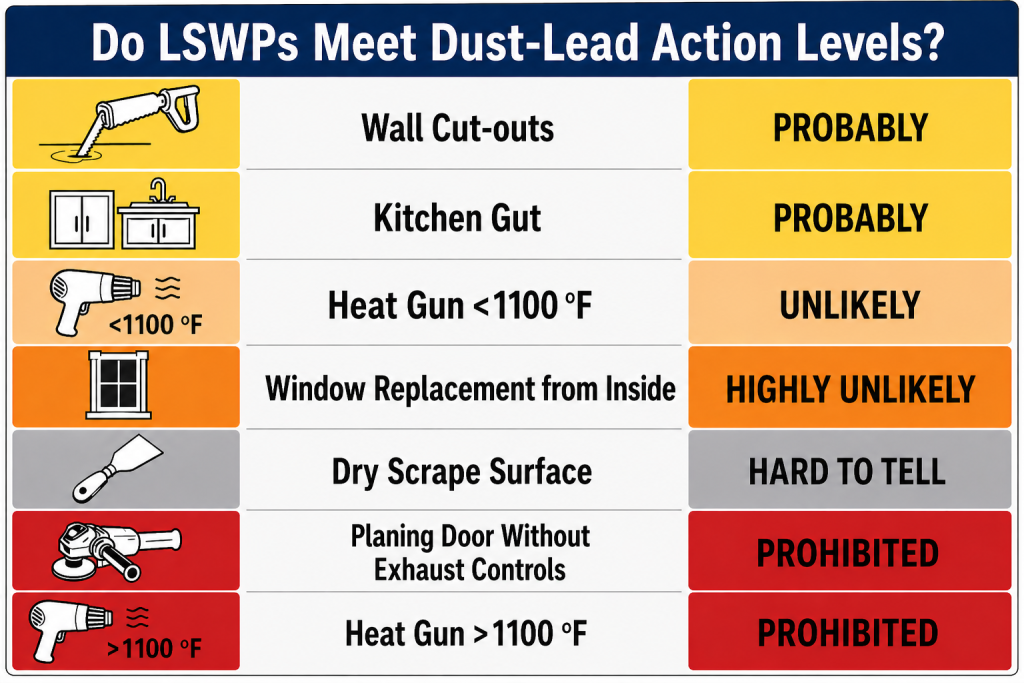
Unleaded Kids was recently asked whether following the Lead-Safe Work Practices (LSWP) in EPA’s Renovation, Repair and Painting (RRP) were likely to ensure that dust-lead levels were below EPA’s dust-lead action level of 5 micrograms of lead per square foot (µg/ft2). We looked into EPA’s 2007 Dust-Lead Study,1on which the RRP was based, to find the answers in Table C2.3a for eight scenarios.
- Wall Cut-outs – Probably: EPA evaluated 12 variations where trained renovators made 3 cut-outs of 2 foot or more section of wall disturbing 6 ft2 of LBP. After post-cleaning verification, the median dust lead level on the floor was 5 ug/ft2 with 75th percentile of 11 ug/ft2 and max of 124 ug/ft2. EPA found a 2% chance of exceeding pre-2018 dust-lead hazard standard of 40 ug/ft2. As a caution, see limitation #2 below.
- Kitchen Gut – Probably: EPA evaluated eight variations where trained renovators simulated gutting of a kitchen that disturbed 100 ft2 or more of LBP. After post-cleaning verification, the median dust lead level on the floor was 5 ug/ft2 with 75th percentile of 27 ug/ft2 and max of 326 ug/ft2. EPA found a 19% chance of exceeding 40 ug/ft2. As a caution, see limitation #2 below.
- Heat Gun <1100 – Unlikely: EPA evaluated four variations where trained renovators remove paint from 75–100 ft2 of LBP components by using a heat gun less 1100° Fahrenheit held at one inch or the distance specified from paint. After post-cleaning verification, the median dust lead level on the floor was 18 ug/ft2 with a minimum of 5 ug/ft2 and max of 102 ug/ft2. EPA found a 25% chance of exceeding 40 ug/ft2.
- Window Replacement – Highly Unlikely: EPA evaluated eight variations where trained renovators replaced window from inside of unit that disturbed 2 ft2 or more of LBP. After post-cleaning verification, the median dust lead level on the floor was 41 ug/ft2 with a minimum of 16 ug/ft2 and max of 212 ug/ft2. EPA found a 59% chance of exceeding 40 ug/ft2.
- Dry Scrape Surface – Hard to Tell: EPA evaluated eight variations where trained renovators dry scraped deteriorating 50-75 ft2 LBP from interior walls by hand. After post-cleaning verification, the median dust lead level on the floor was 33 ug/ft2 with a minimum of 5 ug/ft2 and max of 137 ug/ft2. EPA found a 44% chance of exceeding 40 ug/ft2. The levels were so high that EPA restricted this activity so it can only be used “with heat guns or around electrical outlets or when treating defective paint spots totaling no more than 2 ft2 in any one room, hallway or stairwell or totaling no more than 20 ft2 on exterior surfaces unless wet methods were used. The study did not evaluate the use of wet scraping.
- Dry Plane Door Without Exhaust Controls – Prohibited: EPA evaluated eight variations where trained renovators scraped or dry planed 20-40 ft2 of LBP from an interior door using a high speed machine without a shroud or exhaust controls to contain dust. After post-cleaning verification, the median dust-lead level on the floor was 140 ug/ft2 with a minimum of 18 ug/ft2 and max of 2,583 ug/ft2. EPA found an 88% chance of exceeding 40 ug/ft2. The levels were so high that EPA prohibited this activity unless the machines “have shrouds or containment systems and are equipped with a HEPA vacuum attachment to collect dust and debris at the point of generation” and are “operated so that no visible dust or release of air occurs outside the shroud or containment system.”
- Heat Gun > 1100 – Prohibited: EPA evaluated 12 variations where trained renovators removed paint from 75-100 ft2 of lead-based painted components by using a heat gun over 1100° Fahrenheit held at one inch or the distance specified from LBP. After post-cleaning verification, the median dust lead level on the floor was 94 ug/ft2 with a minimum of 5 ug/ft2 and max of 5,206 ug/ft2. EPA found an 63% chance of exceeding 40 ug/ft2. The study showed the dust-lead levels created were so significant that EPA prohibited it as well as “open-flame burning or torching of painting surfaces.”
Some important considerations:
- The levels are after post-cleaning verification. EPA found that “the cleaning verification process . . . resulted in decreases in lead levels, but under the conditions of the study was not always accurate in identifying the presence of levels above EPA standards for floors and sills.”
- EPA’s study results are based on the average of four samples in the work room and two in the tool room and in the observation room. However, if optional dust clearance sampling is done, each dust-lead level must be below the action level of 5 ug/ft2, no averaging allowed.
- The lab method used for dust-lead samples had a minimum detection limit of 10 µg total lead per sample. Some samples were apparently taken of 2 ft2 to report down to 5 ft2.2
- The type and condition of the floor make a difference. EPA found higher levels for wood and for floors in poor condition. See Tables 6-30 and 6-31.
- The people who conducted the study knew they were being observed and may have been particularly attentive to following the details.
- OBSERVER STUDIES
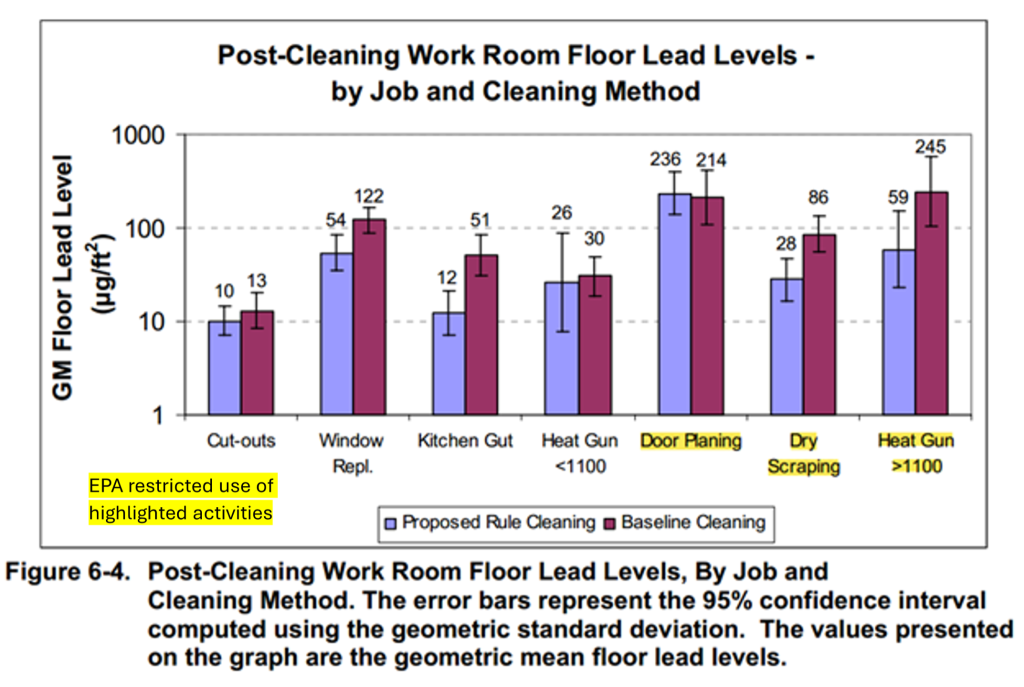
The figure below summarizes the impact of cleaning. Note that it does not appear to consider levels found after post-cleaning verification, which EPA found to decrease lead levels.
What It Matters
EPA established the RRP’s LSWPs in 2008 based on an analysis of the costs of compliance and the potential benefits. While it used the dust-lead hazard standard of 40 ug/ft2 as a benchmark for comparison, the agency did not ensure dust-lead hazards would be eliminated. For that reason, it provide property owners and residents with the option for dust-clearance testing in lieu of the cleaning.
LSWP’s shortcomings are worse as EPA has tightened the dust-lead standards. It seems likely that most renovations leave significant dust-lead hazards behind that put residents at risk.
Our Take
Since 2009, EPA has developed and refined tools to better assess the societal benefits of reducing lead exposure. EPA should use those tools to strengthen the rule’s LSWPs to require dust-lead clearance for projects not likely to meet the dust-lead action level. Based on EPA’s lead dust study, these projects involve use a heat gun, interior window replacement, dry scraping, or dry planning (even with exhaust controls).
As part of those revisions, EPA should extend the RRP requirements to public and commercial building consistent with its statutory duties and its commitments to the U.S. Court of Appeals in 2009. See EPA’s RIN 2070-AJ56 in its unified regulatory agenda for details.
Until EPA revises the RRP, for renovations that are not likely to meet the action level without additional efforts we encourage:
- States to strengthen their RRP to require dust clearance testing in these high risk activities and include public and commercial buildings.
- Lead-safe advocates and community based organizations working with RRP certified contractors to … alert property owners and residents.
- Property owners and residents contracting for renovation services to require that the project pass post-renovation dust clearance testing that meets the action levels.
Enjoying Unleaded Kids’ insights? Consider making a donation to help us continue our work.
Get Unleaded Kids’ insights delivered to your inbox as soon as they are published by joining our email list.
- Note that the study was conducted at 15 vacant houses and one child-occupied facility in Columbus and Pittsburgh that had lead-based paint (as measured by an XRF) ranging from 0.8% to 10.2% for interior jobs. It also evaluated exterior projects. We will cover those results in a later blog. ↩︎
- EPA found that 30% of the post-verification cleaning levels were below the method detection limit of 5 ug/ft2.It was 12% in the tool room and 30% in the observation room. See Table C1.1. See Table 6-34 for averaged results that were sometimes below 10 ug/ft2. ↩︎