
What Happened
In April, Unleaded Kids posted a blog laying out issues to consider in EPA’s anticipated revisions to lead-based paint soil-lead standards. Our goal was to start a discussion of the options well before the agency proposes revisions to the existing standard early next year.
We continued that discussion at the National Lead and Healthy Housing Conference in New Orleans, beginning with a breakout session followed by many productive conversations in hallways and over meals—a valuable reminder of the importance of in-person events.
The most contentious issue was our recommendation that soil samples be sieved with a 250 micrometer wire mesh. For context, fine granulated sugar should pass through this mesh size.
We recommended that the action level and hazard standard should be based on this fine fraction because it: 1) presents the greatest risk of being ingested, and 2) the lead concentration is likely to be between 1.5 and 9 times higher than in the coarse fraction or the total sample. In addition, EPA’s blood lead models are based on this fine fraction.
People at the conference raised two concerns with our sieving recommendation:
- Sieving will increase the time and cost to collect and process samples. Samples must be dried to less than 10% moisture, which is tough to do in the field. In addition, the mesh must be thoroughly cleaned between each use. This handling can result in errors. One person put it plainly by asking if the juice was worth the squeeze.
- The total sample may include paint chips and other lead debris that children may ingest but that would be screened out of the fine fraction.
Fortunately, Dr. Howard Mielke, Adjunct Professor at Tulane University School of Medicine and a leading expert on the hazards of lead in soil, pointed us to an innovative sampling alternative based on his decades of groundbreaking work on lead poisoning prevention in New Orleans. In a 2007 study, he called the sampling method PLOPS—Potential Lead On Play Surfaces—and designed it to represent the soil most likely to stick to a child’s sweaty hand. Conceptually, it has many advantages over typical soil sampling, whether sieved or not.
What is PLOPS?
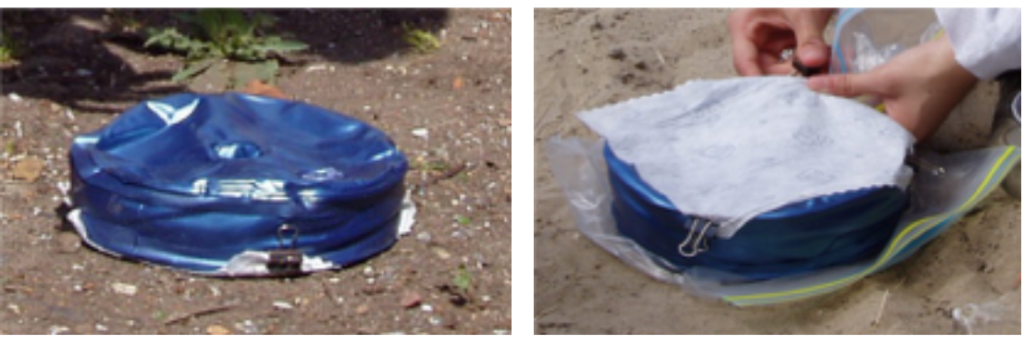
The sampling method starts with a cylindrical bag about 7 inches in diameter and a couple of inches tall. It is filled with 1 liter of water. The same type of wet wipe used for interior dust wipe samples is clipped at the corners to the bag. See Figure 1.
The technician taking the sample flips the bag, so the wet wipe is in direct contact with bare soil, then rotates it a quarter-turn one direction and then back. The person flips it back, so the wipe is facing up, unclips the wipe, and puts the dirty wipe in a test tube to go to a lab for analysis—just like an interior dust wipe sample.
The Mielke et. al, study concluded that “the PLOPS results provide insight into the potential of soil for transferring [lead] either directly, via hand-to-mouth behavior, or indirectly, via track-in and [lead] dust resuspension.” The study found that soil lead “concentration underestimates the potential for [lead] exposure from the soil surface. The PLOPS tool provides a measurement that is comparable with interior floor wipes because it measures the amount of [lead] per area a child is likely to encounter while at play on the soil surface.”
How PLOPS Differs from Typical Soil Sampling?
To understand how PLOPS is different than typical soil sampling, whether sieved or not, it is important to recognize how children are exposed to lead in soil. In its 2016 cleanup guidance, EPA described three routes of exposure.
- Stick to skin and be ingested from hand-to-mouth activities;
- Build up indoors as dust from wind-blown soil where can be ingested and inhaled.
- Be tracked in on clothes, shoes, pets, toys, and other objects where it can be ingested.
Let’s explore each route separately.
Stick-to-skin: Like interior dust-wipe sampling, PLOPS is a direct measurement of how much lead will stick to the skin should a child touch the bare soil. Both use a wet wipe to simulate a child’s sticky hand. By measuring lead loading, the methods combine both the amount of soil or dust and the concentration of lead in the soil or dust. Note that EPA already has estimates of hand-to-mouth activities of young children indoors and outdoors.1
Back in 1998, when EPA proposed a dust-lead hazard standard, it considered the issue of lead loading versus concentration.2 It settled on a dust wipe (loading) rather than vacuum sampling (concentration) because “wipe sampling is the method that most risk assessors use. In contrast, few risk assessors are skilled in vacuum sampling.”
In contrast, typical soil sampling only considers the concentration of lead in soil (whether total or fine fraction). It does not consider how much soil may stick to a child’s hand. The fine fraction may be a closer measure because it is more likely to stick to a child’s hand, but it says little about the amount.
The extremes may be helpful to show the difference. A child playing in gravel is likely to have little soil stick to the hand. The loading will be small even if the concentration is high. In contrast, a child playing in the mud is likely to have a lot of soil sticking to the hand. The risk of ingestion is high even if the concentration is low.
Wind Blown Soil: Lead in soil that is blown in from outdoors through windows and around doors shows up as dust-lead on floors and window sills. Often, it is difficult to distinguish whether the indoor dust-lead is from deteriorated interior lead-based paint or from outside.
The concentration of lead in soil that has been sampled down to 1 inch deep is difficult to translate into how much might be blown indoors because it measures the amount that may be buried (rather than exposed to the air) and it does not measure how much may be picked up and carried indoors. In contrast, PLOPS provides a better, though not perfect, measure.
Tracked in: Similar to soil blown indoors, the concentration of lead in a soil that has been sampled down to 1 inch deep is difficult to convert into how much might be tracked in on clothes, shoes, pets, toys, and other objects. In contrast, PLOPS provides a better, though not perfect, measure.
Why It Matters
The reality is that, outside of gardens and sandboxes, the most significant risk is posed from the fine soil right at the soil surface. At the surface, the lead can move around—whether on a child’s hand or by a lawnmower, leaf blower, or weed whacker. By collecting only the soil right at the surface, the PLOPS method should be a better reflection of the risk than the fine fraction of a sieved soil sample collected from the top one inch.
PLOPS also addresses a significant shortcoming of a sieved sample collection when very little soil is small enough to pass through the sieve. The PLOPs method measures the amount—not the concentration—of lead in the fine fraction. In this way it is similar to a dust-wipe sample.
As we explained in our April blog, virtually all of the soil that sticks to a child’s hand is smaller than 250 µm. A 2014 study by Laidlaw et al., in Sydney, Australia, made a compelling case that the fine soil fraction is a major contributor to interior dust lead, especially in the dry summer months when fine soil can be tracked into the home or blown in through windows.
What About Paint Chips in Soil Sample?
One significant problem with using the fine fraction of a soil sample for a risk assessment is that it removes paint debris that can have the highest levels of lead.
For abatement clearance, it should not be a problem since the certified inspector or risk assessor must first conduct a visual inspection. “If deteriorated painted surfaces or visible amounts of dust, debris or residue are present, these conditions must be eliminated prior to the continuation of the post-abatement testing procedures.”
However, the situation is different for risk assessments where the goal is to represent what a child may ingest. HUD’s Guidelines at Appendix 13.3 says, “if paint chips are present, they should not be avoided and should be included in the sample. When sampling play areas, avoid including grass, twigs, stones, and other debris in the sample.”
The PLOPS method should address the problem by collecting what is at the surface including visible paint debris. However the Mielke et. al, study did not evaluate that aspect.
Our Take
We see the PLOPS sampling method as a potential game changer because it:
- Should avoid the cost, delay, and potential errors associated with sieving samples.
- Is a straightforward, simple approach that conceptually extends interior dust wipe sampling to the outdoors.
- Should be able to collect the paint debris for risk assessments.
Unfortunately, we found no evidence that anyone had attempted to reproduce the method after almost 20 years. Without substantial evidence showing the results are reproducible in different settings and soils by a variety of people, it is not ready for EPA to incorporate into its proposed soil-lead standards. And the time it would take is too long to warrant delaying those standards.
In the meantime, we encourage researchers and practitioners to give PLOPS a try and evaluate its potential benefits. We also ask that Congress restore the dedicated grant funding to HUD for Lead Technical Studies that was cut in the FY26 budget. In the absence of that dedicated funding, HUD could use healthy homes funds to study the issue and build a rigorous evidence base that EPA would require.
Enjoying Unleaded Kids’ insights? Consider making a donation to help us continue our work.
Get Unleaded Kids’ insights delivered to your inbox as soon as they are published by joining our email list.
- EPA’s Child-Specific Exposure Factors Handbook (2008, Final Report). See Tables 4-10 for indoor frequency of hand-to-mouth frequency by age and Table 4-11 for outdoor frequency by age. ↩︎
- June 3, 1998 Federal Register notice at page 30335. See https://www.govinfo.gov/content/pkg/FR-1998-06-03/pdf/98-14736.pdf. EPA acknowledged that vacuum sampling can also provide loading if “a specialized vacuum cleaner is used to collect dust from a surface with known area. Through laboratory analysis, the amount of lead picked up by the vacuum can be measured and compared to the surface area to calculate loading.” EPA acknowledged that both loading and concentration provide insights saying “With the concentration data, the risk assessor would be able to conclude that house A, with the high dust-lead concentration, has an on-going source of lead that needs to be identified and controlled. In house B, high loading combined with low concentration may indicate the presence of excessive dust that could be addressed through routine housecleaning.” It concluded “vacuum samples require significantly more time to collect because the equipment needs to be cleaned between samples, resulting in higher costs for risk assessments. EPA, therefore, believes that a standard based on loading alone is more workable than a standard that uses both measures. For those risk assessors that use vacuum sampling or other methods of dust sampling, the Agency is planning to provide guidance on the use and interpretation of concentration data.” ↩︎