
What Happened
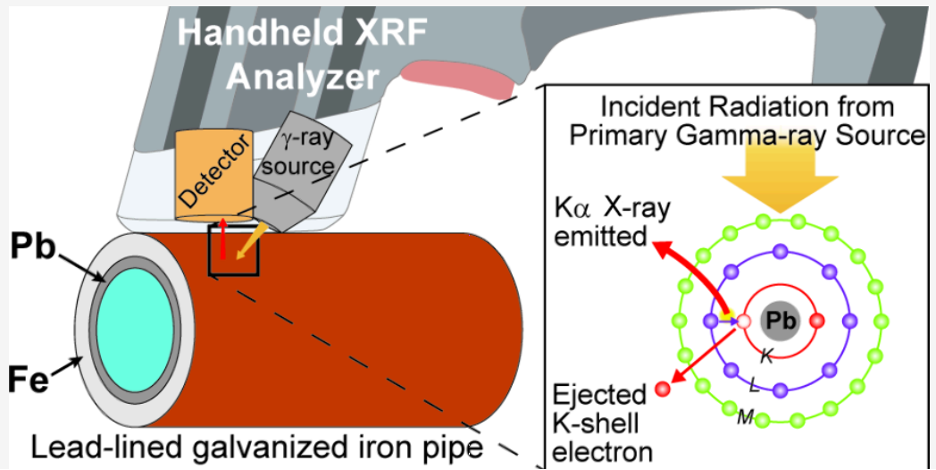
EPA’s scientists published important research finding that handheld, x-ray fluorescent devices (XRFs) that use radioactive 57cobalt can correctly identify lead-lined galvanized iron pipe (LLGIP) from the outside of the pipe without damaging it. In lab conditions, these handheld XRFs were able “to differentiate with 100% accuracy between LLGIPs and GIPs” without a lead lining.1
These handheld 57cobalt XRFs work by generating gamma rays that impact the K-shell of a lead atom. Other radioactive sources such as cadmium would also work.
Handheld XRFs that rely on an x-ray tube do not generate gamma rays and their x-rays are unlikely to penetrate the iron pipe wall and reliably identify the lead lining. For a refresher on XRFs and electron shells, University of Georgia has a helpful resource.
Why It Matters
The outside of an LLGIP looks the same as a GIP that is not lined with lead.2 There is no way to visually tell them apart without damaging them.
Without a tool or means to reliably distinguish between LLGIP and GIP without a lead lining, utilities are likely to mistakenly classify the service line as “Non-Lead” even though EPA’s Lead and Copper Rule (LCR) considers it to be an LSL. As an LSL, utilities are expected to replace the LSLs they have access to by 2037 because it releases high levels of lead into drinking water. They also must notify customers annually that their LSL needs to be replaced.
Note that utilities have until 2034 to validate that any identified service lines they have classified in annual inventories3 are “Non-Lead.” All other types of service lines (LSLs, Galvanized Requiring Replacement (GRR), and “Lead Status Unknown” to which they have access to are expected to be replaced by 2037.4
Now, utilities have a tool—an XRF with 57cobalt—that has been shown to identify LLGIPs from the outside of the pipe without disturbing it.
Since GIPs are galvanized service lines, don’t they require replacement?
GIPs that are not lined with lead must only be replaced by 2037 if it is or ever was downstream of an LSL.5 These are called GRRs.
If a utility can demonstrate that the unlined galvanized iron pipe was never downstream of a LSL, it is not a GRR and the service line does not have to be replaced.6
How common are LLGIPs?
It is unknown. However, they are common enough that their potential presence cannot be ignored because a Massachusetts company made many millions of feet of LLGIP in the late 1800s and early 1900s. The pipe was apparently used in drinking water distribution systems, service lines that connect water mains to homes and buildings, and, possibly, interior plumbing. The lead lining prevented corrosion on the inside of the iron pipe that would choke off the flow of water.
LLGIP may be commonly found in the Northeast, Mid-Atlantic, and Midwest. They were also “installed along the Pacific Coast throughout the late 1920s and early 1930s as an experimental material along with copper tubing.”
Would an X-Ray Tube XRF Suffice?
Of the handheld XRFs in common use, Viken’s Pb200 is the only model we know of that features 57cobalt. Because service lines are buried in the ground, Viken also offers an adapter that allows the XRF to be inserted into an 8 inch diameter hole where it can contact the pipe and be operated remotely to distinguish LLGIP from GIP that is not lead lined.
Most other handheld XRFs that we are aware of, including the popular SciAps X-series, use an x-ray tube to generate the x-rays to identify lead. Unfortunately, a typical x-ray tube does not generate x-rays energetic enough energy to penetrate through the GIP to “see” the lead lining on the inside. In the study, EPA estimated that only 1% of the energy would penetrate through a 3 mm GIP wall compared to 54% for a 57cobalt XRF.7
Our Take
We applaud EPA for conducting this study and identifying a viable alternative to distinguish between LLGIP and GIP without a lead lining. While EPA’s study used pipes taken from decommissioned service lines in the ground, we encourage the agency to work with utilities to evaluate how well the technology works on different configurations or where there is excessive exterior corrosion or coatings in the field. See Figure S1 in the study’s supporting information.
We also encourage utilities to consider using a handheld XRF with a radioactive element such as 57cobalt to correctly identify LLGIPs and avoid the risk of mistakenly treating them as “Not Lead” in their service line inventory.
Finally, we ask those who have handheld XRFs with radioactive element to consider checking interior plumbing that is galvanized pipe to check for a lead lining that could release high levels of lead in drinking water. Note that the XRF will need to be reporting in counts of lead and not milligrams per square centimeter that is used for paint.
- The XRF was less successful distinguishing between LLGIP and leaded brass. However, brass can be identified from the outside visually or with a magnet. ↩︎
- EPA flagged this in its guidance for complying with the LCR Revisions. See page 2-6 (28 of 164 of the PDF). ↩︎
- Utilities must submit to the state annual updates of their service line inventories starting in 2027. They must also make these inventories public. For those serving more than 50,000 customers, the inventory must be online. ↩︎
- There are two primary exceptions to this deadline: 1) the public water system does not have access to the LSL despite many attempts; and 2) more than 39% of its public water system’s service lines in 2024 had to be replaced. In this second circumstance, the water system can ask the state for more time to comply. ↩︎
- “If the water system is unable to demonstrate that the galvanized service line was never downstream of a lead service line, it is a galvanized requiring replacement service line for purposes of the service line inventory and replacement requirements pursuant to § 141.84.” ↩︎
- Note that a service line with a short section of lead pipe known as a lead connector (also called a gooseneck or pigtail) is not sufficient on its own to make the service line an LSL or GRR. Utilities must replace lead connectors when encountered during planned or unplanned water system infrastructure work unless the connector is not under the control of the system. ↩︎
- See Table S2 in the study’s supporting information. ↩︎