
What Happened
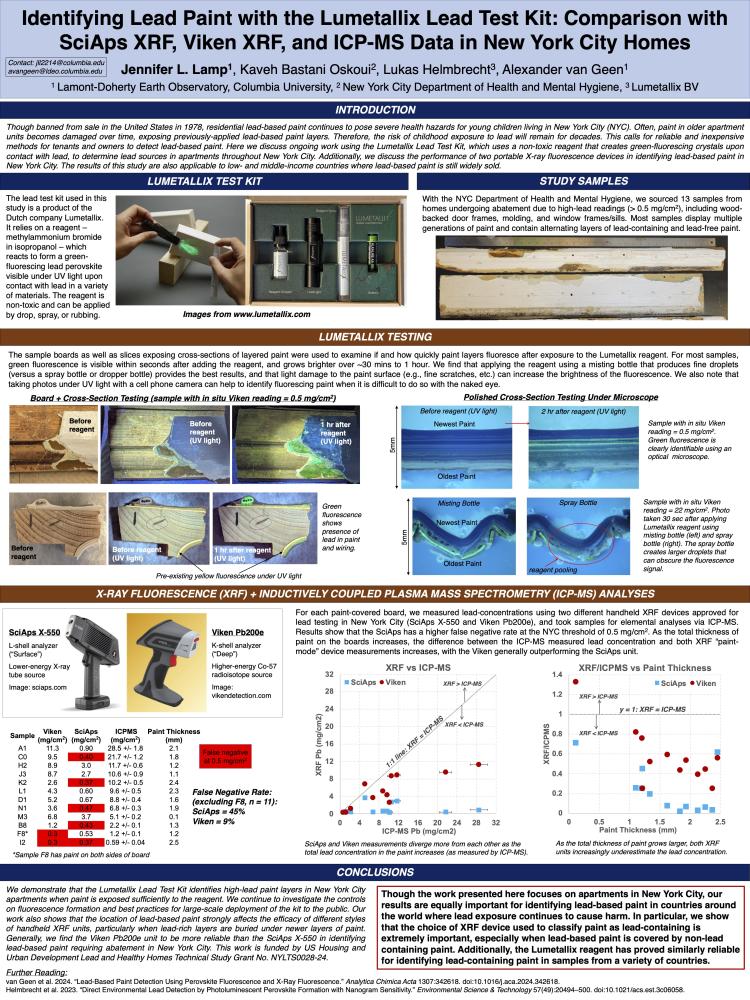
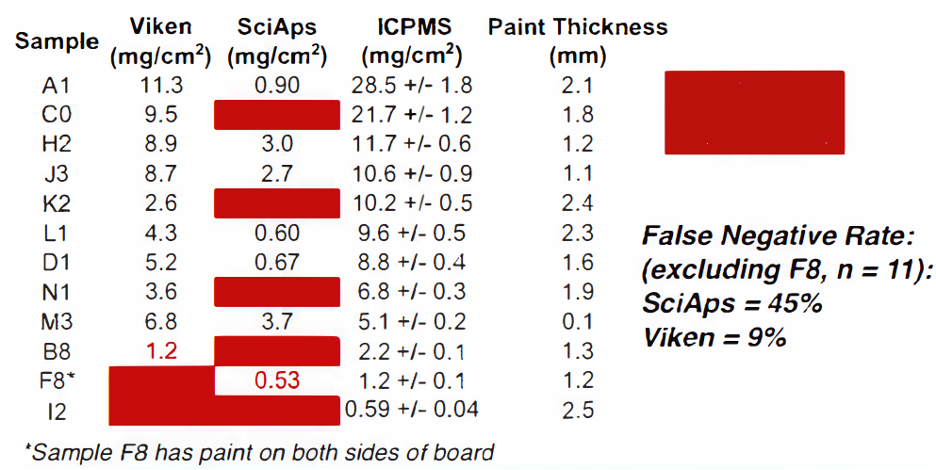
Several people sent Unleaded Kids a LinkedIn ad from Viken Detection claiming a HUD-funded Columbia University study showed that SciAps’ handheld x-ray fluorescence (XRF) model X-550 had a 45% false negative rate on paint compared to samples analyzed by ICP-MS. The ad said the study showed Viken’s handheld XRF model Pb200e had a 9% false negative rate. Both models had lead-based paint performance characteristic sheets (PCS) from HUD.
Based on the queries and a July EPA study flagging similar concerns on lead-lined galvanized pipe for drinking water service lines, Unleaded Kids decided to investigate. We find that the concerns are legitimate and strongly encourage HUD and EPA to respond by:
- At a minimum, updating the painted architectural components that were collected in 1993 and are used to evaluate XRFs. The updated components should reflect those that are currently in use and have been repeatedly painted over the years.
- Include samples that only have paint with less than 90 ppm of lead to enable the XRFs to be evaluated against this modern paint limit.
- Use the changes as a foundation to review and update their definition of lead-based paint, pursuant to an order to EPA by the Ninth Circuit Court of Appeals in 2021.
Why It Matters
A false negative means lead-based paint is present, but the tool says it is not there. This is a serious problem because it says that the paint need not be abated. It also means that any contractors disturbing the paint will be allowed by EPA and HUD lead-based paint rules to use dangerous work practices, such as torching or machine sanding the paint without dust collection. These dangerous work practices would likely leave extraordinarily high dust-lead levels in a home, putting the family at significant risk of lead poisoning. A family living in the home would have no idea of the risk until the child’s blood-lead levels show serious harm that warrants a costly cleanup.
The Problematic Definition of Lead-Based Paint
Back in 1992, Congress defined lead-based paint to mean “paint or other surface coatings that contain lead in excess of 1.0 milligrams per centimeter squared or 0.5 percent by weight.” It authorized HUD and EPA to tighten the limits but gave the agencies no criteria to select different cutoffs. See 15 U.S.C. 2681(9). In their implementing regulations, EPA and HUD kept the Congressional limits unchanged.
The cutoffs in the law were based on an understanding at that time of what was and was not leaded paint — in the 1970s. The limits were not based on the risk to children if the paint was disturbed or deteriorated.
Recognizing that paint containing less than 5,000 parts per million (ppm) of lead could pose a hazard if disturbed or deteriorated, EPA agreed to reconsider the limits in response to a 2009 citizens’ petition. Unfortunately, the agency took no further action. In 2021, the Ninth Circuit Court of Appeals ordered EPA to review the limits and ensure the definition of lead-based paint adequately protected families from lead. See press release by Earthjustice for context on the court order.
In response to the court order, EPA and HUD held a virtual workshop in 2023 but have not taken further action. For its part, EPA chose to focus first on updating its dust-lead standards and then its soil-lead standards. The definition of lead-based paint was classified as a long-term action without a timeline. With deep staff cuts at both agencies under the new Administration, it is uncertain when the agencies will conduct the review.
To the best of our knowledge, New York City is the only jurisdiction that has tightened the federal limits, cutting them in half in 2019 with Local Law 66.
Note that for new residential paint, in 20081 Congress tightened the limit of lead to 90 ppm, down from 600 ppm where it had been since 1978. See 15 U.S.C. 1278a. The law directed CPSC to review the limit every five years and revise downward the limit to the “lowest amount of lead that the Commission determines is technologically feasible to achieve.” CPSC had not done that review until Unleaded Kids and others demanded it in 2024. In June 2026, the Commission concluded, in a seriously flawed decision,2 not to tighten the lead limits.
What Did the Columbia University Study Find
The study was conducted by respected researchers at Columbia University. They compared SciAps XRF, Viken XRF, and ICP-MS data3 in New York City homes with Lumetallix lead test kits pursuant to a HUD Technical Study Grant. The study was published only as a poster and not through the peer-review process.
We prefer peer-reviewed studies especially when they make significant claims such as these. The peer-review process provides greater scrutiny by outside experts, and the publication provides more space for the authors to explain the methodology.4 For that reason, we reached out to the corresponding authors, Jennifer Lamp and Alexander van Geen. They said they fully intend to seek publication of the study in a peer-reviewed journal, explained the study in more detail, and answered our questions.
The researchers compared the XRF performance to the NYC definition of lead-based paint—which are half of the federal limits. Based on the table below, if we used the federal limits of 1.0 mg/cm2, the false negative rate for Viken would remain 9%, but the SciAps’ rate would increase from 45% to 64% (7 of 11 results).5
In addition, the figure below indicates that the SciAps XRF has a greater error than the Viken XRF when the paint is thicker. Presumably, the paint is thicker because of fresh coats of low-lead paint added over the decades. This suggests that zinc or possibly other metal salts such as titanium may interfere with the SciAps.
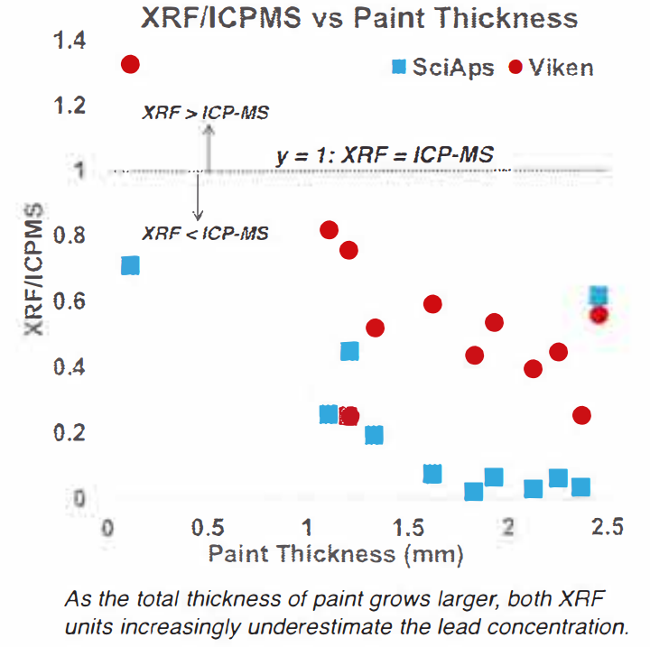
The researchers concluded that “generally, we find the Viken Pb200e unit to be more reliable than the SciAps X-550 in identifying lead-based paint requiring abatement in New York City … In particular, we show that the choice of XRF device used to classify paint as lead-containing is extremely important, especially when lead-based paint is covered by non-lead containing paint.” It is important to note that the reliability claim is based on a method the researchers developed based on NYC’s Local Law 66 that says, “if laboratory analysis is used to determine lead content, results shall be reported in milligrams of lead per square centimeter.” Under this method, the paint sample is collected by drilling through the paint into the substrate. The paint and substrate removed by the drill is then digested in acid and analyzed with ICP-MS. The concentration is converted based on the weight of the sample and diameter of the drill bit.
HUD’s Performance Characteristic Sheets (PCSs)
Both the Viken Pb200e and SciAps X-550 handheld XRFs have PCSs from HUD. This means HUD has confirmed the XRF can distinguish between lead-based paint and non-lead-based paint pursuant to the HUD/EPA methodology established in 1997. EPA and HUD effectively require that any XRF used to conduct a lead-based paint inspection have a PCS.6
The PCS relies on more than 100 architectural components collected in 1993 from ten single-family houses in Denver, Colorado, four units of a multifamily housing development in Louisville, Kentucky, and eight units of a multifamily housing development in Philadelphia, Pennsylvania. The homes were built between 1890 and 1952. Building materials that contained the targeted test locations were collected and later assembled into the EPA/HUD archive facility.
The K-Shell and L-Shell Difference and HUD’s PCSs
As we explained in our August blog, EPA’s scientists published important research finding that handheld, XRFs that use radioactive 57cobalt can correctly identify lead-lined galvanized iron pipe (LLGIP) from the outside of the pipe without damaging it. In lab conditions, these handheld XRFs were able “to differentiate with 100% accuracy between LLGIPs and GIPs” without a lead lining.1
These handheld 57cobalt XRFs work by generating gamma rays that impact the K-shell of a lead atom. Other radioactive sources such as cadmium would also work.
Handheld XRFs that rely on an x-ray tube do not generate gamma rays and their x-rays are unlikely to penetrate the iron pipe wall to reliably identify the lead lining. For a refresher on XRFs and electron shells, University of Georgia has a helpful resource. The image below from the study may also be helpful.
While galvanized iron pipe is an extreme example compared to layers of new paint, we think that the lesson may be relevant to explaining the results found by the Columbia researchers. Zinc oxide (or perhaps another common metal salt such as titanium dioxide used in modern paint) may be interfering with the ability of the SciAps to “see” the lead in the oldest layers of paint.
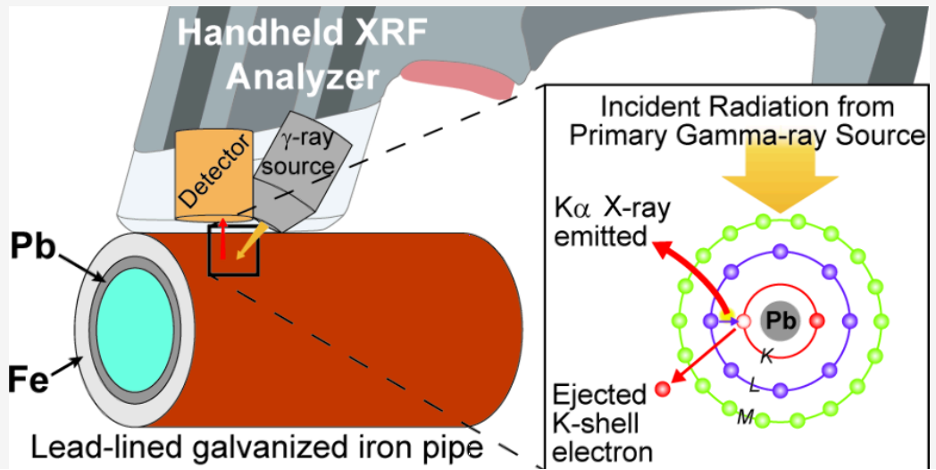
Figure 1: Image from DiSantis, Villalona, and Tully, Service Line Characterization via Handheld Lead K-Shell X-Ray Fluorescence, Ecotoxicology and Public Health, July 9, 2026.
Our Take
EPA and HUD should also use the update as an opportunity to:
- Include samples that only have paint with less than 90 ppm of lead to enable the XRFs to be evaluated against this modern paint limit.
- Use the changes as a foundation to review and update their definition of lead-based paint, pursuant to an order to EPA by the Ninth Circuit Court of Appeals in 2021.
Note that we shared a draft of this blog with the corresponding authors of the research as well as SciAps and Viken. We made edits based on the responses we received as appropriate.
- Congress enacted Consumer Product Safety Improvement Act of 2008. ↩︎
- The Commission acted on a staff assessment that did not evaluate the capability of the XRF or lab methods to measure a lower level of lead. Rather they said “there have been no new or improved testing capabilities generally available to commercial or government laboratories that would support reproducible and reliable testing for lead content significantly lower than the current limits. The two main analytical methods CPSC uses to measure lead are X-ray Fluoresce spectroscopy (XRF) and Inductively Coupled Plasma Optical Emission Spectroscopy (ICP-OES). Limits of Detection (LODs) are the lowest level an instrument can detect in a certain substrate and are determined using ideal, homogeneous materials. LODs for both XRF- and ICP-based methods have not significantly changed over recent years. As such, achievable limits of quantification for real-world children’s product samples have remained unchanged since passage of the CPSIA.” The staff failed to consider that Congress established much stronger criteria for the 5-year reviews than in the initial review. ↩︎
- Note that they converted the results of the ICP-MS lab analysis into mg/cm2 consistent with NYC Local Law 66 because they concluded they were able to accurately measure the surface area of the paint chip. ↩︎
- In addition, one of the study authors was the inventor of the Lumetallix text kit raising conflict of interests for that aspect of the study. However, the blog is focused on the XRF aspects not Lumetallix. ↩︎
- The uncertainties in the ICP-MS data in the figure are those from the ICP-MS measurement only; they do not consider the imperfect method of sampling, heterogeneity in the boards, or other sources of error prior to the mass spec measurement. ↩︎
- 40 CFR 745.227(b)(3) requires use of a documented methodology. 40 CFR 745.227(a)(3) describes HUD Guidelines as a documented methodology. HUD’s 2012 Guidelines at Chapter 7, Section I.C.1. states “If an XRF analyzer does not have a PCS, or if it is not used, or if the data are not analyzed, in accordance with its PCS, the actions undertaken with it are neither a lead-based paint inspection nor paint testing.” ↩︎